Youth in Action: How One High School Student is Keeping WWI History Alive
Published: 30 July 2026
By Susan Walsh
Doughboy Foundation staff writer
Screenshot
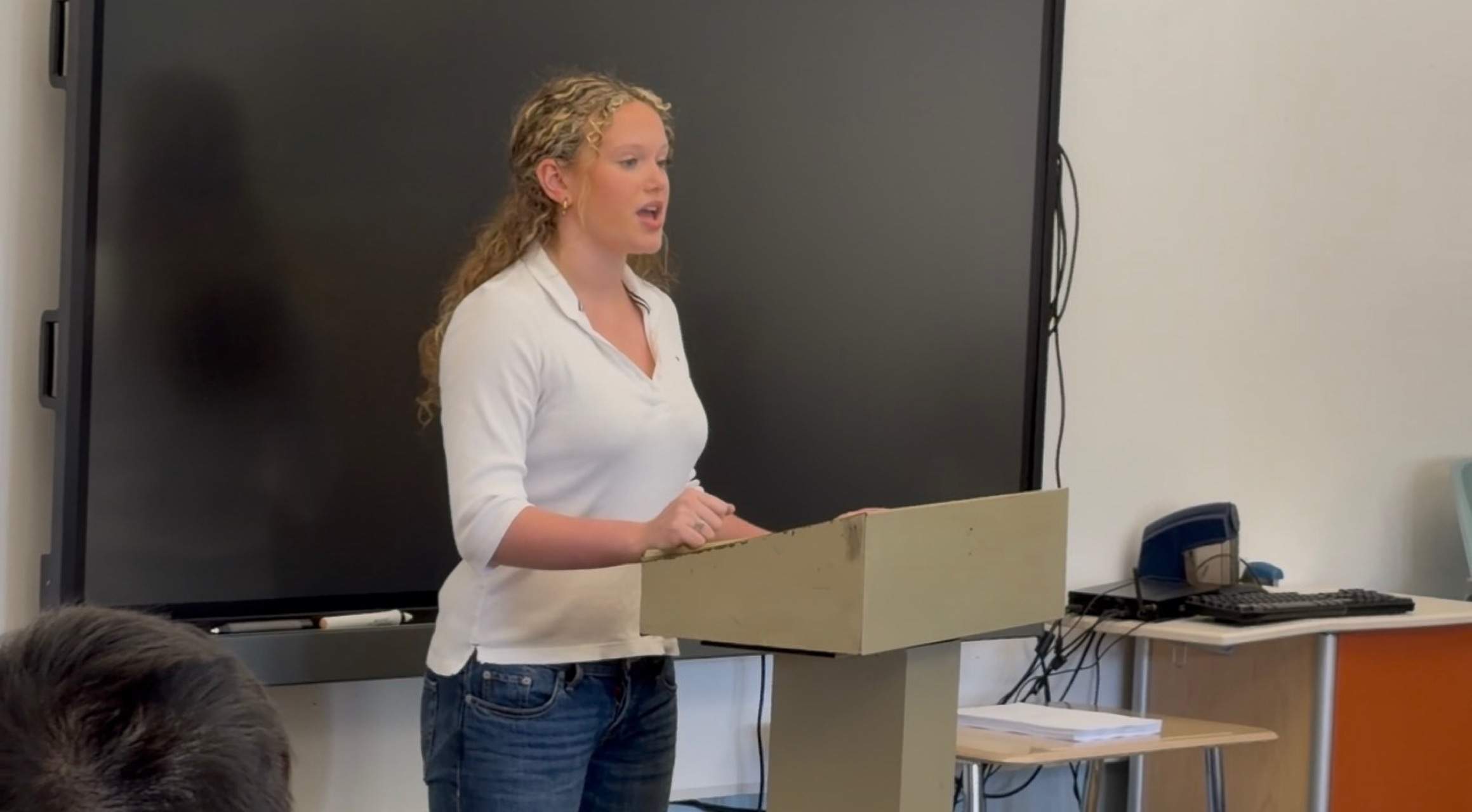
Juliette McEnroe speaking to the assembled Bronxville High School at the "Lest We Forget: A Memorial Day Gallery Event" in 2026.
Dispatch: Juliette, as a student leader, you bridge the gap between academic history and Gen Z. Many of our readers are historians and older generations who have spent their lives remembering our veterans. Why is it important for them to see young people like you carrying this torch forward?
Juliette: It is important for young people to carry this torch forward because history will otherwise be forgotten. I hope it brings your readers comfort to know that the stories that they have cared about for so long are not lost. I have a personal connection to World War One– both my mother and father’s families served in various ways. There are students like myself who recognize the importance of service, and history, and are ready to put in the work to have it be vividly felt.
Bringing History to the Halls of Bronxville High School
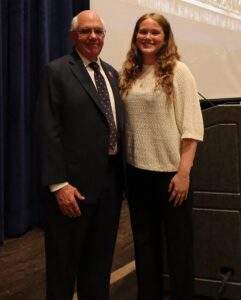
Daniel Dayton and Juliette McEnroe
Dispatch: You recently organized the impressive “Lest We Forget: A Memorial Day Gallery Event” at Bronxville High School alongside your advisor, Mrs. Dana Landesman. What inspired you to turn a traditional holiday assembly into a hands-on museum experience?
Juliette: Typically, holiday assemblies at my school are speaker events with students dozing off to long presentations. In Spring 2025, Dan Dayton got their attention with a riveting talk about trench warfare. I showed fascinating historical footage given to me by Theo Mayer (my advisor through the Doughboy Foundation). My conversation with Dan was very successful and many students asked questions. I sensed interest in our audience and kept going. For Veteran’s Day 2025, Mitch Yockelson agreed to come. After his terrific speech, students wanted a closer look at his resources, especially his battle maps. I realized how the students wanted to interact with history rather than just hear about it.
For this year’s Memorial Day, I was inspired to construct an interactive museum in a gallery walk – with posters I created from photographic material and flags, newspapers (brought by Mitch) and my own mother’s sheet music collection of World War One songs. There were helmets, uniforms and shells provided by my teachers. There was lively conversation in the hallways with Mitch and the history department, and I created a fun questionnaire to guide exploration and encourage opinions.
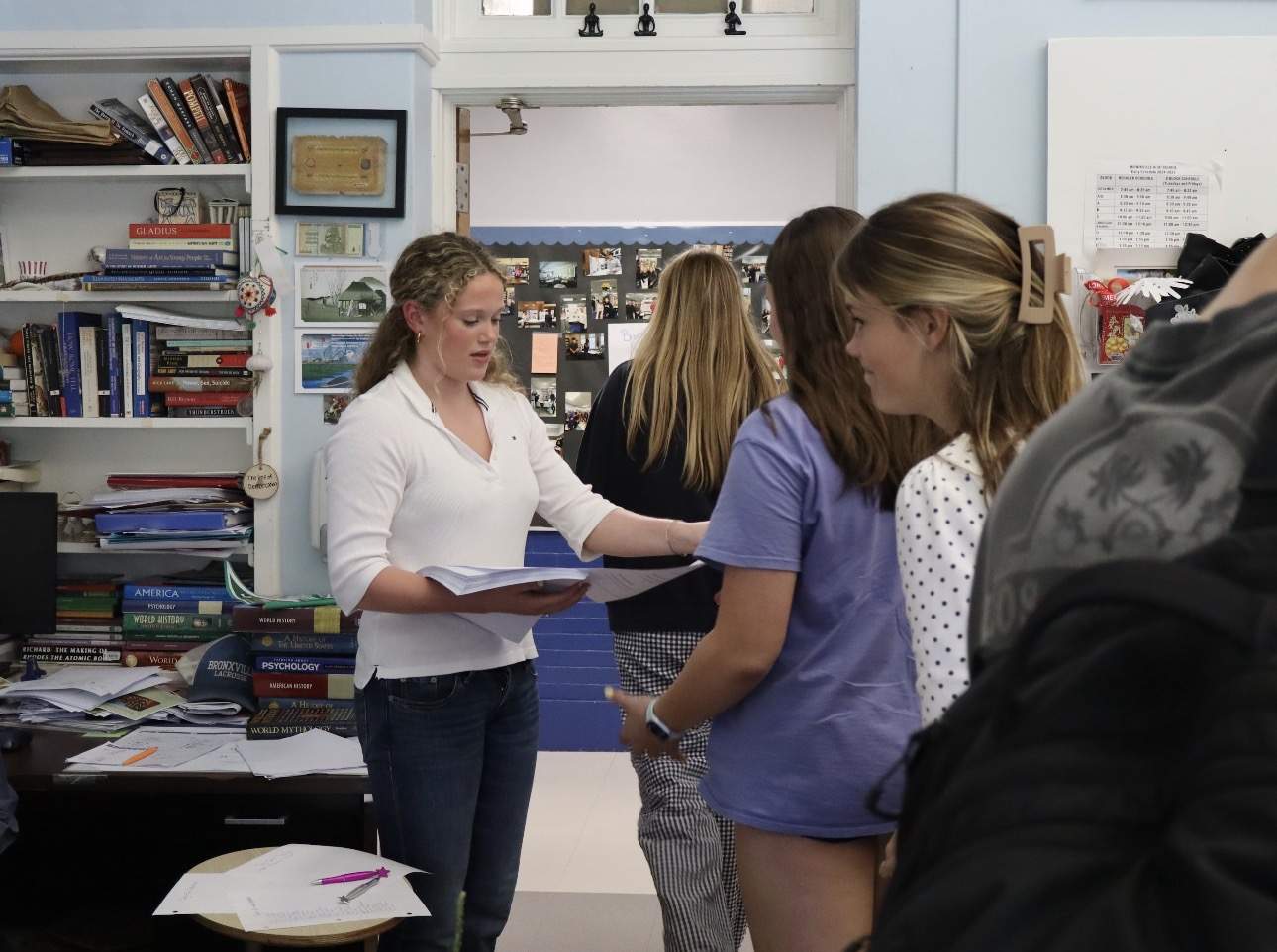
Juliette McEnroe (left) distributes guides to students at her “Lest We Forget: A Memorial Day Gallery Event” at Bronxville High School.
Dispatch: Your gallery event featured five distinct learning stations covering everything from local history to wartime media. Which of these stations seemed to spark the most curiosity or debate among your classmates?
Juliette: The station I noticed sparked the most curiosity was one that showed the military history of our hometown, Bronxville. I laid old newspaper clippings I found of articles encouraging the town to buy war bonds during the Second World War, and images of landmarks and famous streets during times of war. A specific image of our school’s flagpole being established in 1926 to honor Bronxville’s soldiers was of particular interest. It was quite moving, seeing it decorated with flowers a hundred years ago– a familiar view so long ago. You could look out a hallway window, now in 2026, and see the same flagpole surrounded by a completely different world.
Dispatch: What was the most surprising reaction or question you heard from your fellow classmates during Mitch Yockelson’s visit?
Juliette: In his speech, Mr. Yockelson encouraged us to go to a cemetery and look at the headstones, and write down the name of a specific soldier. He said, “Look for an individual and do some research, find some facts about this person. Maybe when they died they were only 3 or 4 years older than you.” He said it isn’t enjoyable but it is important to do. And he told us about a soldier from the Second World War that he had researched once, who loved his guitar. He made us understand that boys, and girls, no older than us – but much like us– had to endure some of the most frightening situations. I noticed how my classmates began to listen once it was made clear the sacrifices young people had made. People we read about in history books were actually just kids like us.
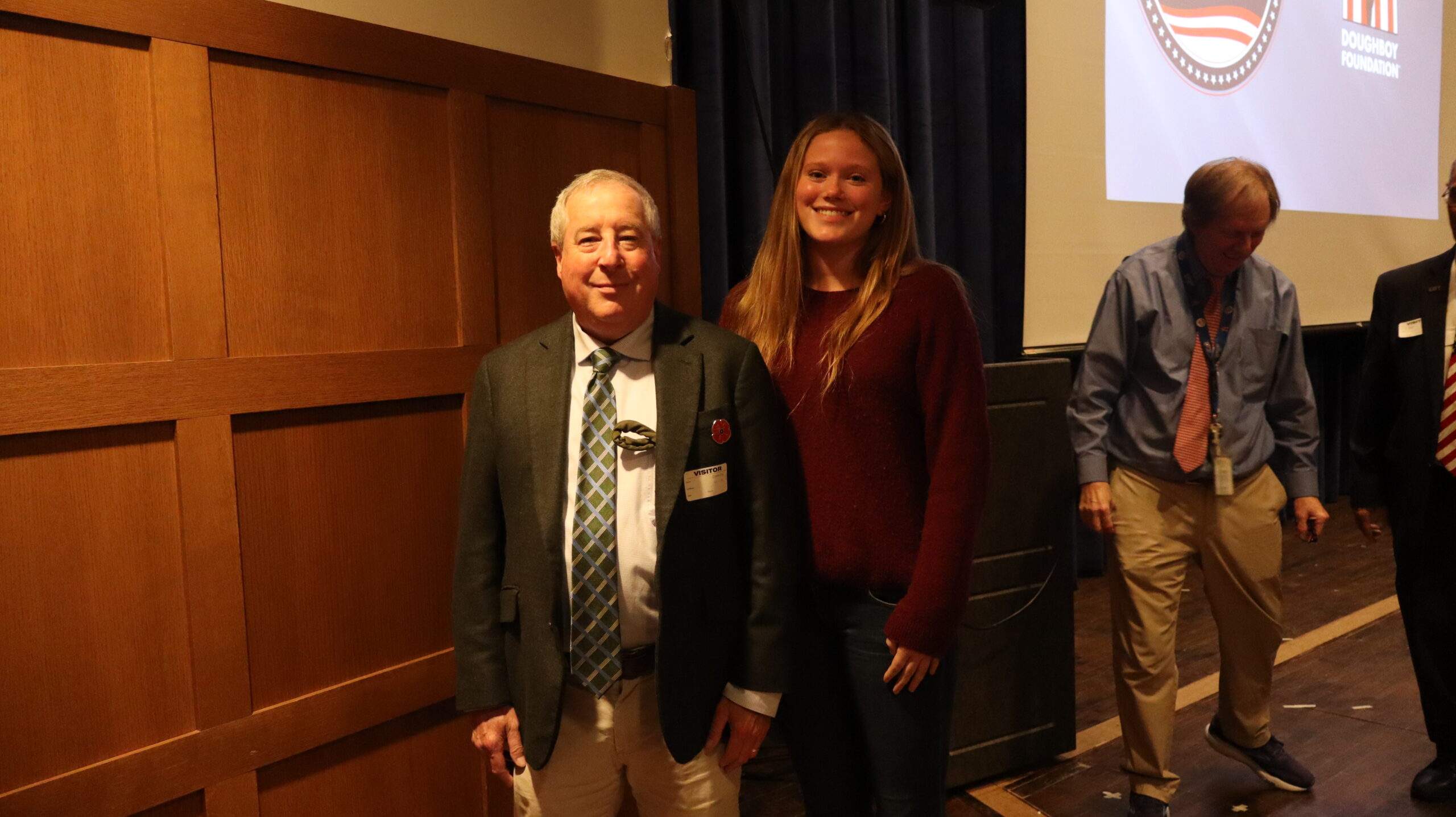
(l to r) Mitch Yockelson and Juliette McEnroe at the “Lest We Forget: A Memorial Day Gallery Event” at Bronxville High School.
Bringing WWI to the Digital World
Dispatch: Moving from the school hallways to the digital world, you head off the Youth Doughboy Instagram page. What is your secret to translating heavy historical themes into modern, visual social media content for a scrolling Gen Z audience?”
Juliette: I started right away to try to set some of the basics – What is a poppy? What is the Doughboy Foundation? But quickly I decided to think of imagery that would intrigue young eyes– things like sports, donuts, animals, and music. Elephants, zebras, and camels played roles in war. Did you know Taylor Swift has a song called “The Great War?” I made a reel about this popular song which has themes of the First World War in it, even though it’s a breakup song. I showed the lyrics and took it line by line- like “place a poppy in my hair” and “you drew up some battle lines.”
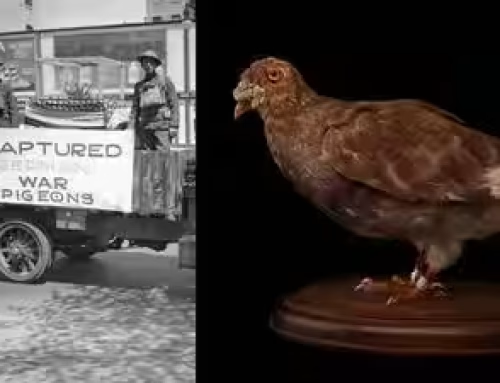
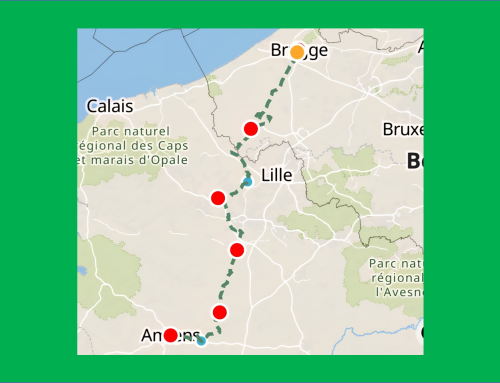
Sharing content on social media is the best way to attract an audience today, especially if the goal is younger generations. I try to dial it all down: find little stories that hold a lot of meaning and share them in approachable ways. The visuals and language you use on Instagram are vital to capture a scrolling teenager’s attention. I try to use bright colors and quick, eye-catching statements like “Bird Saves Battle”– which is from one of my favorite WWI stories!– about the pigeon named Cher Ami that carried a desperate message for the Lost Battalion, flying successfully with a broken leg. (France awarded the pigeon the Croix De Guerre!)
Short catchy stories are how we get the engagement of a Gen Z audience.
Dispatch: Is there a specific Doughboy story, photo, or piece of propaganda you posted that personally resonated with you the most?
 Juliette: For this Memorial Day, I posted a reel that was a compilation of film segments of WWI that really hit me in the heart. One scene shows a man sleeping without his helmet on, and his friends look at the camera and start laughing because he isn’t aware he’s sleeping on film. They fiddle with his hat. It’s just a silly friendship moment, but set in a muddy trench with weapons all around them.
I like it because it brings the war to life– we can see the emotion and the bonds of the soldiers. It is important to look through films like this, because it immediately humanizes history and puts it on a personal level.
Looking Forward to the Future of Remembrance
Dispatch: Your exhibit connected WWI remembrance to America’s 250th anniversary. As we look at the world today in 2026, what lessons from the WWI era do you feel are most urgent for today’s youth to understand?
Juliette: As America celebrates its 250th anniversary, I think one lesson we must remember is the importance of working together. World War I proved that our country has so many strengths–immigrants, African Americans, men, women, all of us– and our country is diverse and beautiful and can survive hardships. The Great War was a tragedy, but it also showed that our citizens can come together around a common purpose.
In a time when the world feels divided, history reminds us that cooperation and shared values matter. I think young people today should never underestimate the power of inclusivity, collaboration and the American spirit to overcome challenges.
Dispatch: What advice would you give to another high school student who wants to take history out of the textbook and start a similar advocacy program in their own hometown?
Juliette: Tell them to reach out to me via the Instragram page! The advice I would give them is to follow your passions and not be afraid of your ideas. Some of my most successful moments in sharing history have come from a random idea that I simply decided to explore. Follow any curious facts that strike you.
I would also encourage students to take advantage of the resources around them. Teachers and mentors are often inspired by enthusiasm, and if you approach them with confidence and creativity, you can create something unique. Most importantly, have fun! History is filled with stories that shape our understanding of the present. There is something incredibly rewarding about inspiring others while making discoveries of your own. I’d say: start, go for it.
External Web Site Notice: This page contains information directly presented from an external source. The terms and conditions of this page may not be the same as those of this website. Click here to read the full disclaimer notice for external web sites. Thank you.