Brooke Army Medical Center’s award-winning care honors its WWI-era namesake
Published: 16 July 2026
By Janet A. Aker
via the DIVIDS website
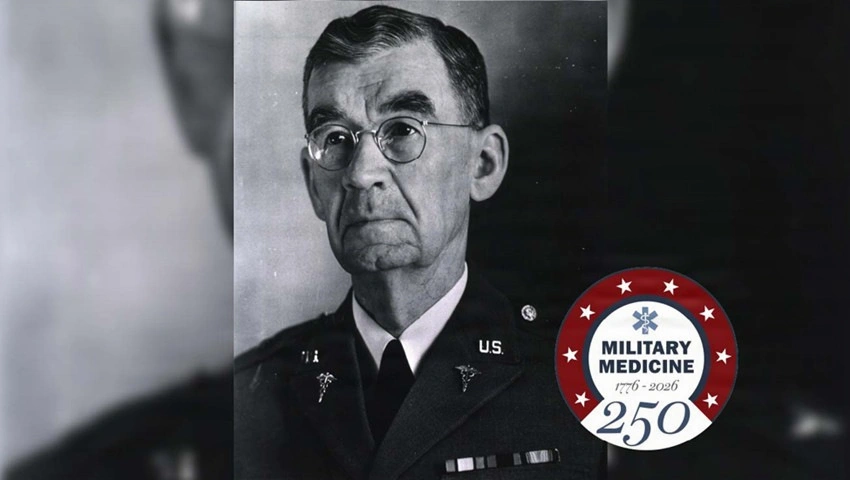
Army Brig. Gen. (Dr.) Roger Brooke
Army Brig. Gen. (Dr.) Roger Brooke served as commanding officer and chief of the medical service of the Station Hospital at Fort Sam Houston, San Antonio, Texas, from 1928 to 1933. Brooke Army Medical Center carries his legacy of military medicine excellence through high-quality warfighter care and nationally recognized patient safety standards. (Photo courtesy of Texas State Historical Association)
This year, the Military Health System is celebrating 250 years of America by recognizing military medicine’s enduring history of innovation and impact to the warfighter. Please join the Military Medicine 250 campaign!”
Pioneering military doctor Army Brig. Gen. (Dr.) Roger Brooke, whose name is honored by Brooke Army Medical Center at Fort Sam Houston in San Antonio, Texas, trained thousands of military doctors and specialized in infectious diseases. The hospital continues the medical foundational figure’s legacy through award-winning care for warfighters.
Education accelerates early military career
Brooke joined the U.S. Army in 1901 after graduating from medical school a year earlier. His first assignment was to the Philippines in 1902. He was assigned to Fort Bayard, New Mexico, in 1905, and in 1911, he became head of medical services at Letterman General Hospital at the U.S. Army’s Presidio in San Francisco, California.
Brooke played an important readiness role during America’s involvement in World War I, leading the Medical Officers’ Training Camp at Camp Greenleaf in Fort Oglethorpe, Georgia, from September 1917 until December 1918.
As the camp’s senior instructor and assistant commandant for 15 months, Brooke oversaw the training of front-line emergency care for about 10,000 medical officers and 70,000 enlisted men, according to a 1970 biography in the journal Military Medicine. For his leadership, he received one of the first Distinguished Service Medals — the country’s highest award for meritorious service or achievement.
Honoring Brooke’s teaching legacy, BAMC is the largest force-generating platform, hosting training and education specialty programs through the San Antonio Uniformed Services Health Education Consortium.
Discovering a deadly disease
Brooke was also a leader in the research of infectious diseases, particularly the airborne bacterial disease tuberculosis, and shepherded the use of chest X-rays in the military to screen for the disease.
Tuberculosis remained a readiness issue in WWI and World War II among those deployed overseas, according to a 2017 public health journal article, “Tuberculosis Screening and Control in the US Military in War and Peace.” The author is a Uniformed Services University physician and professor of preventive medicine, James Mancuso, a retired U.S. Army colonel.
Brooke’s interest in controlling the disease started at Fort Bayard, according to Mancuso’s article. The U.S. Army had set up a sanatorium there to provide nonmedical treatment for tuberculosis after cases spiked in the military during the Spanish-American War.
Brooke and other military scientists’ expertise led to the use of chest X-rays in the mid-30’s and during WWII to check draftees and volunteers for tuberculosis. Today, healthcare providers use chest X-rays for tuberculosis diagnosis in addition to blood and skin tests.
In January 1920, Brooke was named chief of the tuberculosis section of the Office of the U.S. Army Surgeon General, Washington, D.C. His later tours of duty included the Veterans Bureau as chief medical consultant; Gorgas Hospital in the Panama Canal Zone, and Fort Sam Houston, Texas.
Read the entire article on the DIVIDS website.
External Web Site Notice: This page contains information directly presented from an external source. The terms and conditions of this page may not be the same as those of this website. Click here to read the full disclaimer notice for external web sites. Thank you.