The enduring mystery of a Navy ship that sank in the Bermuda Triangle
Published: 8 July 2026
By Stephen Ruiz
via the WE ARE THE MIGHTY website
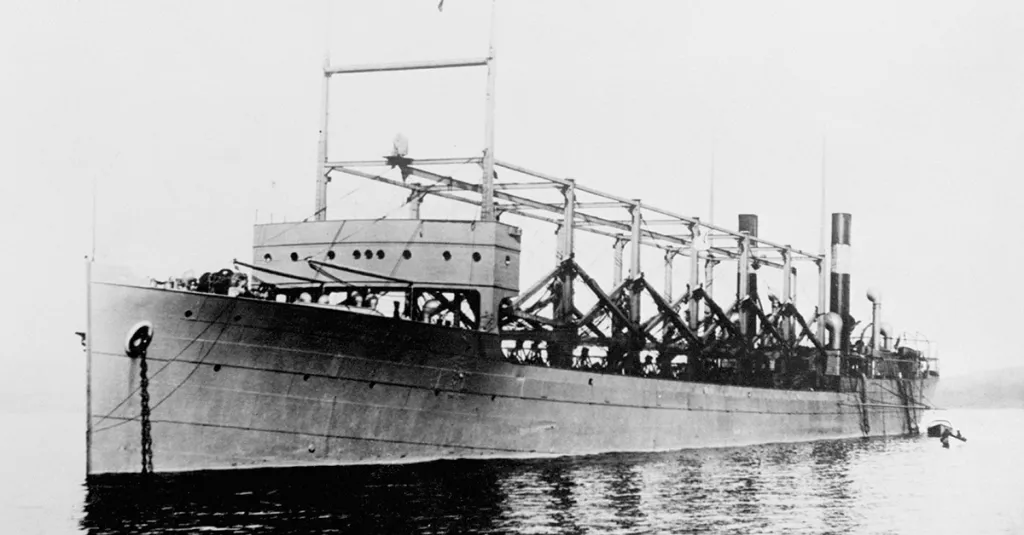
uss-cyclops-navys-biggest-ship-getty
The U.S. Navy collier Cyclops was last seen on March 4, 1918, en route from Barbados to Baltimore. (Getty Images)
The USS Cyclops’ last message: “Weather Fair, All Well.”
Named after a mythological one-eyed figure, the USS Cyclops just disappeared.
The U.S. Navy bulk cargo ship departed Barbados for Baltimore on a scheduled nine-day voyage. The vessel—540 feet long and 65 feet wide—carried more than 300 people along with approximately 11,000 tons of manganese ore. The metal is a key ingredient in steelmaking and heavy artillery.
The last known sighting of the Cyclops was on March 4, 1918. It went down in the Bermuda Triangle, that mysterious stretch of the North Atlantic Ocean in which roughly 50 ships and 20 airplanes reportedly were lost over the years.
The Bermuda Triangle produces a deep well of conspiracy theories whenever a ship or aircraft goes missing. The Cyclops was no different. In the aftermath of its disappearance, Navy search crews found no trace of a sunken ship. They came across no evidence of debris or an oil slick on the water. More importantly, they recovered none of the passengers’ remains.
“Usually a wooden bucket or a life preserver identified as belonging to a lost ship is picked up after a wreck, but not so with the Cyclops,” Capt. E.K. Roden wrote in Santa Fe Magazine. “She just disappeared as though some gigantic monster of the sea had grabbed, men and all, and sent her into the depths of the ocean, and the suddenness of her destruction is amplified by the absence of any wireless calls for help being picked up by any ship along the route.”
One Engine Down
Launched in 1910, the Cyclops became part of the Naval Auxiliary Service. The Navy commissioned it into active service after the United States entered World War I on April 6, 1917. For nearly a year, the Cyclops reliably transported troops and fuel.
The Cyclops departed Norfolk, Virginia, in January 1918 for a nearly three-week trip to transport almost 10,000 tons of coal to Rio de Janeiro. After arriving in Brazil, the crew offloaded the coal and replaced it with manganese ore. Manganese ore is much heavier than coal, and the Cyclops carried more of it when it departed on February 15.
The Cyclops and its commanding officer, Lt. Cmdr. George W. Worley, stopped as planned more than 700 miles away in Bahia, Brazil, before pulling into Barbados for an unscheduled stop. It left the then-British colony on March 4 without use of one of its two steam engines.
Its last known communication amounted to four words: “Weather Fair, All Well.”
After the Navy’s efforts to locate the Cyclops proved futile, assistant Navy secretary Franklin D. Roosevelt declared the ship lost. The disappearance of the Cyclops remains the single greatest loss of life in noncombat in the Navy’s history.
“In terms of loss of life and size of ship, it’s probably the last great mystery left unresolved,” underwater explorer James Delgado told The Washington Post in 2018.
Read the entire article on the WE ARE THE MIGHTY website here:
External Web Site Notice: This page contains information directly presented from an external source. The terms and conditions of this page may not be the same as those of this website. Click here to read the full disclaimer notice for external web sites. Thank you.