The March that Made the GI Bill: The Complex, Unfinished Legacy of the Bonus Army
Published: 7 July 2026
By Dana Congelosi
via the VeteranLife website
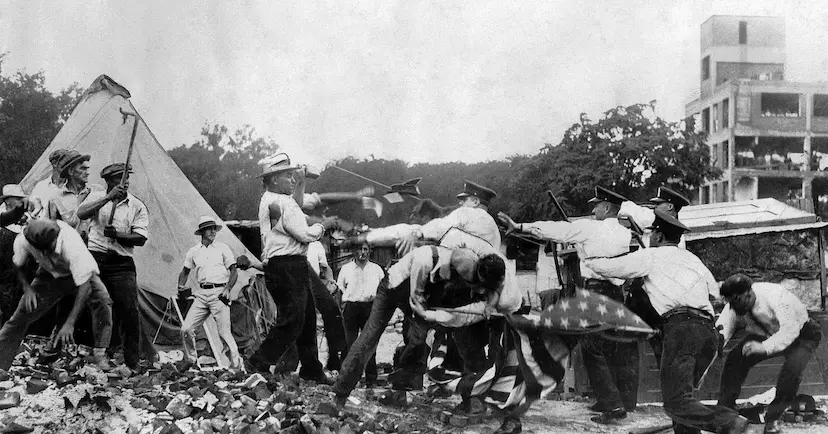
Bonus Marchers. 1932
Bonus Marchers. 1932. 43,000 demonstrators – made up of 17,000 U.S. World War I veterans, together with their families and affiliated groups.
Most people know about the GI Bill, which has extended a number of benefits to American Veterans since the end of World War II. However, many people have never heard of the Bonus Army, a grassroots coalition of destitute World War I Veterans who fought for Veterans’ benefits over a decade earlier, making the passage of the GI Bill possible.
Imagine volunteering to fight a war in a foreign country, or maybe even being drafted, only to return home and find out your pay was less than a 10th of what you could have been earning as a civilian. That was the unfortunate experience of many World War I Veterans returning home when the war ended in 1919.
In 1932, tens of thousands of these Veterans were facing down the Great Depression after a decade of low wages and unemployment. A large group of these Veterans decided to take their plight to Washington, calling themselves the Bonus Expeditionary Force, where they lobbied for the pay they’d been promised.
World War I: The Birth of the Modern U.S. Military
The United States officially entered World War I on the side of the Allied Powers just six months before an armistice was signed on November 11, 1918. Getting involved in the war required the United States to begin a massive mobilization effort to grow its comparatively small standing military.
Prior to World War I, there were at most 300,000 individuals across all branches of the U.S. military. It would need millions of service members to match the size of other countries’ active militaries.
While many Americans did enlist, a draft was also called for. In 1917, the Selective Service Act, as we know it today, was passed in Congress, requiring all men aged 21 to 30 to register with local draft boards. In total, roughly 4.7 million Americans had served in the War, more than half of them drafted into service.
Notably, while the Selective Service Act applied equally no matter an individual’s race, the U.S. military was still heavily segregated. Additionally, Black servicemembers were largely limited to working in menial support roles and served almost exclusively under white officers.
World War I was also the first war that saw American women serving their country in an official capacity. The Navy began a limited program allowing women to enlist and serve as Yeomans, doing clerical work on U.S. Naval bases. The Army and Navy both also welcomed women into the Nurse Corps, through which many served on the front lines. While these women didn’t have the formal ranks of their male counterparts, they did return from the war as Veterans.
Other women served as civilian employees of the military, notably the Hello Girls, 223 women who made up the Army Signal Corps. These women faced extreme danger on the front lines, translating between American and French forces.
Missed Earnings, Ongoing Unemployment, and Low Wages
By the end of the war, just over 100,000 Americans had died in service to their country, and an additional 200,000 were wounded. The rest returned home and attempted to return to normal life.
President Woodrow Wilson proclaimed November 11 to be Armistice Day, in honor of American World War I Veterans (it would later be changed to Veterans Day to honor all Veterans after the Korean War). However, World War I Veterans needed more than a federal holiday in their honor.
During their service, these Veterans were paid $1.25 a day for overseas service and $1 a day for domestic service. Meanwhile, workers at shipyards or in other civilian defense jobs were paid 10 to 15 times more. A Senate investigation at the time even reported that enlisted servicemembers were paid “very much less than that received by the lowest class of laborer at home.”
Even though their time in service was brief, this was a huge setback for many Veterans who returned home to face a post-war recession that resulted in low wages and rising unemployment. The American Legion and the Veterans of Foreign Wars lobbied for a one-time bonus to be paid to these Veterans to make up the gap in pay.
In 1924, Congress passed the World War Adjusted Compensation Act, also known as the Bonus Act. Veterans were awarded interest-bearing certificates with a face value of up to $625. But there was a catch – the certificates couldn’t be redeemed until 1945.
Read the entire article on the VeteranLife website here:
External Web Site Notice: This page contains information directly presented from an external source. The terms and conditions of this page may not be the same as those of this website. Click here to read the full disclaimer notice for external web sites. Thank you.