War Dogs: More Than a Weapon
Published: 10 July 2026
By Master Sgt. Opal Vaughn-Montanez, USA
via the Army University Press NCO Journal website
War Dogs header
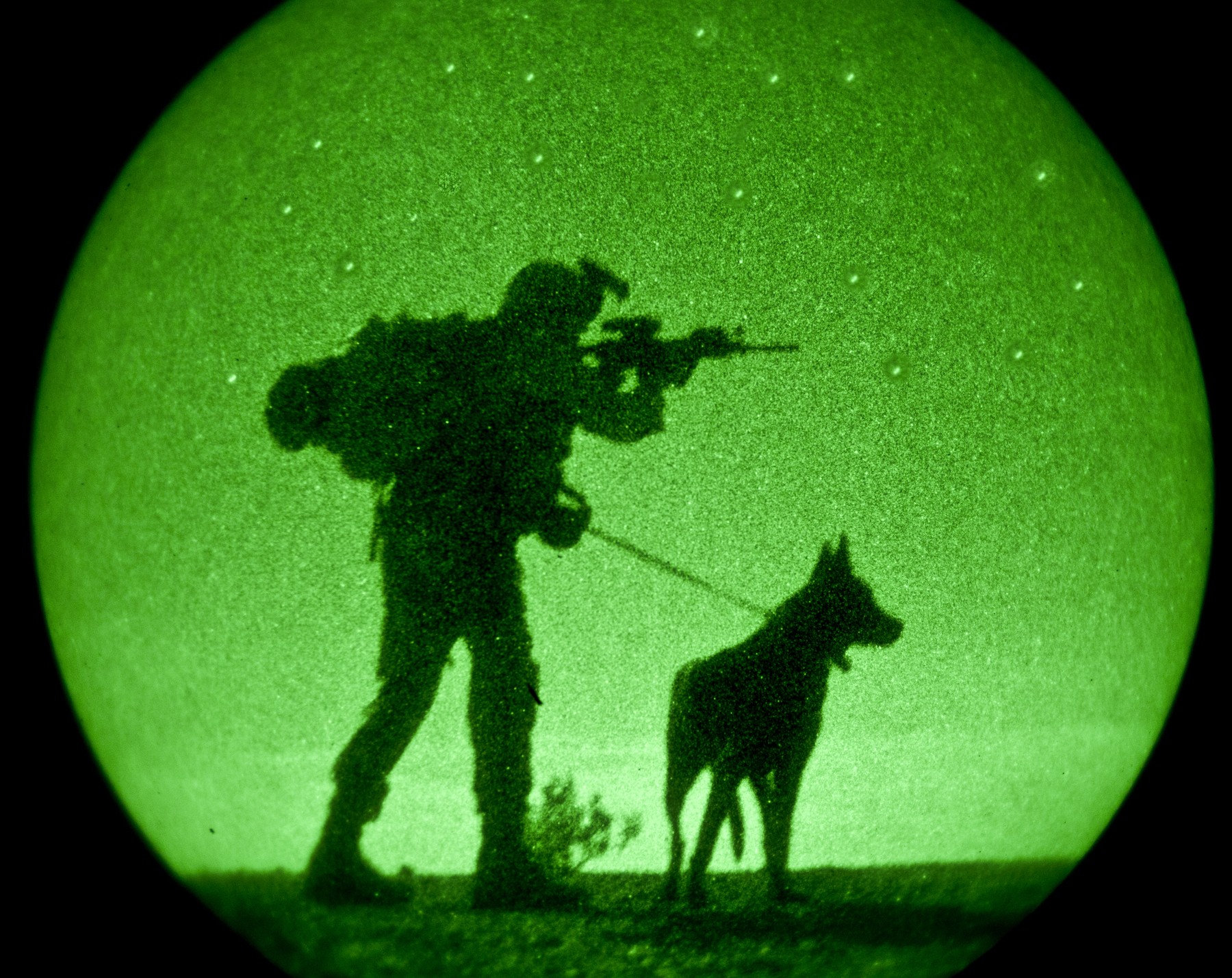
Throughout American military history, military working dogs have served as scouts, sentries, and protectors, quietly shaping battlefield outcomes. Though often overshadowed by human heroics and technological advancements, they've consistently provided a tactical advantage through their unmatched sensory abilities and adaptability. (U.S. Marine Corps photo by Cpl. Aaron Diamant)
World War I marked a pivotal turning point, transforming military dogs from informal assets into formally trained and assigned tactical tools.
The night air over Abbottabad, Pakistan, carried the faint smell of dust and smoke drifting from nearby cooking fires. Two modified MH-60 Black Hawk helicopters skimmed over rooftops and power lines before descending into the walled compound where operators believed the world’s most wanted man was hiding.
As the Navy SEALs sprinted from the aircraft into the darkness, one figure moved differently from the rest – lower to the ground, faster, silent. A Belgian Malinois named Cairo surged forward on a short leash, nose sweeping the dirt for explosives and armed guards (Forer, 2011). Cairo didn’t understand the mission’s significance or the name Osama bin Laden. He understood scent, discipline, and trust.
Months earlier, Cairo had been on a mission and suffered gunshots to the chest and front leg. When his handler called out, there was no response. His handler later found Cairo bleeding heavily and struggling to breathe. The radio call, “friendly wounded in action” went out, making no distinction between a canine and human casualty (Chesney & Layden, n.d.). Cairo was a Navy SEAL.
On the mission to hunt down bin Laden, Cairo’s role was simple: detect danger before danger detects the team.
His presence in the 2011 raid that killed bin Laden wasn’t an anomaly. It represented the culmination of a military tradition that predates the U.S. itself. Long before night-vision goggles and drones, armies relied on animals to compensate for human limitations.
Horses hauled cannons, transported wounded Soldiers, and carried cavalry into battle. Pigeons carried messages for miles through blankets of arrows and artillery fire. Dogs guarded camps, tracked enemies, and warned of ambush.
Throughout American military history, canines have served as scouts, sentries, and protectors, quietly shaping battlefield outcomes. Though often overshadowed by human heroics and technological advancements, military working dogs have consistently provided a tactical advantage through their unmatched sensory abilities and adaptability.
The U.S. Army has a long history of using military working dogs as tactical instruments. Across conflicts from the Revolutionary War to the War on Terror, canines consistently enhanced detection, protection, and maneuver, directly contributing to tactical success, as exemplified by the pivotal role a dog played in the raid on Osama bin Laden’s compound.
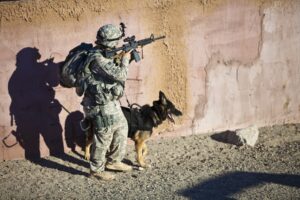
Staff Sgt. Megan Hobson, and her working dog Jalk. Despite satellites, drones, and biometric scanners, the mission still depended on an animal’s nose and training. (U.S. Marine Corps photo by Cpl. Aaron Diamant)
Early American Warfare
Using canines began long before official doctrine existed in the U.S. Army. Drawing on ancient and European traditions, colonial militias during the Revolutionary War informally relied on dogs as indispensable early warning systems.
In an era without modern technology, a dog’s bark could signal approaching enemy patrols, giving encampments critical time to prepare a defense (The U.S. War Dogs Association [USWDA], 2026).
Beyond sentry duty, they also served practical functions, tracking fleeing enemies and carrying messages between dispersed colonial units (Lemish, 1996). This tradition continued into the Civil War, where dogs served as unofficial regimental mascots and guards, reinforcing their role in both security and morale.
Across these early conflicts, dogs consistently proved their value by extending their human counterparts’ sensory range.
World War I marked a pivotal turning point, transforming military dogs from informal assets into formally trained and assigned tactical tools.
Read the entire article on the NCO Journal website.
External Web Site Notice: This page contains information directly presented from an external source. The terms and conditions of this page may not be the same as those of this website. Click here to read the full disclaimer notice for external web sites. Thank you.