The Love of a Brother: The Life of Andrew Arnold Cohill and His Siblings
Published: 25 July 2026
By Katherine Haun
Special to the Doughboy Foundation website
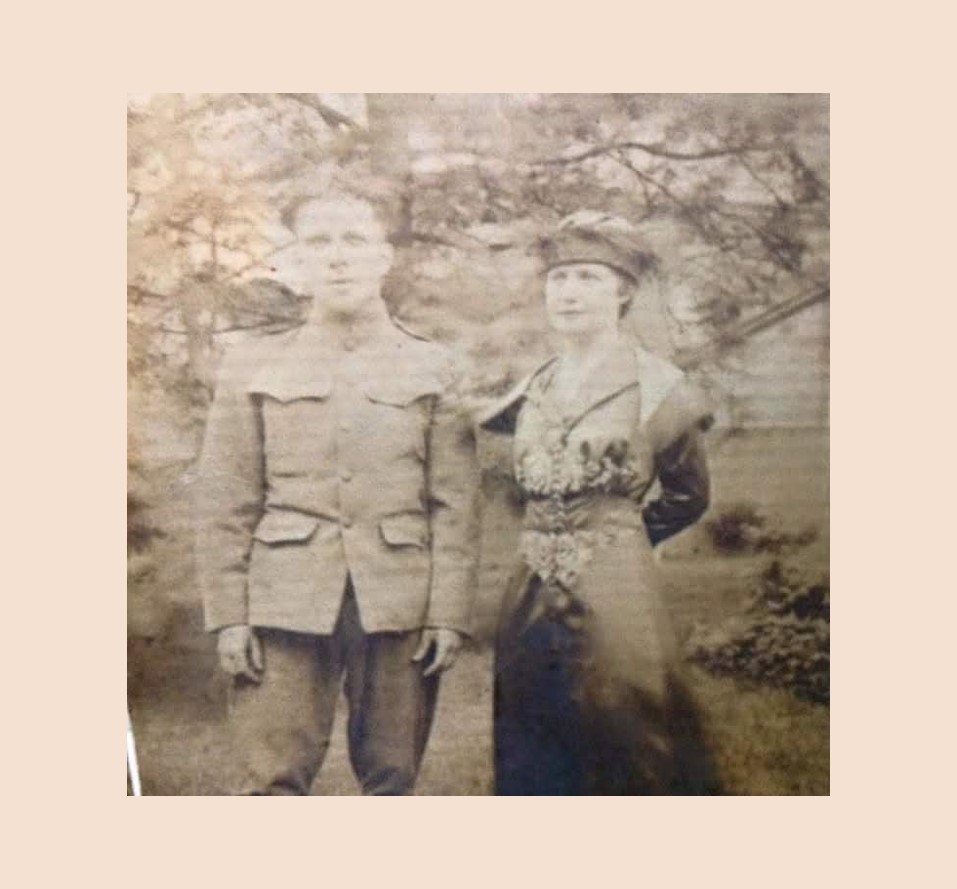
Andrew Cohill with Mercedes A. Good framed
Andrew Cohill with Mercedes A. Good. (Unknown date)
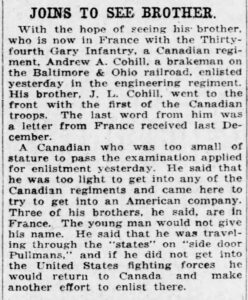
1917 Pittsburgh Post article about Andrew A. Cohill enlistment.
In the Spring of 1917, the Pittsburgh Post reported on the enlistment of a certain Andrew A. Cohill into the conflict that is now known to us as the First World War. The Post detailed this story under the headline “Joins to See Brother” stating, “With the hope of seeing his brother, who is now in France with the Thirty-Fourth Gary Infantry…Andrew A. Cohill…enlisted yesterday in the engineering regiment. His brother, J.L. Cohill, went to the front with the first of the Canadian troops. The last word from him was a letter from France received last December.” This is the first and last detailed mention of Andrew’s service in World War I in any surviving newspaper publication.
On May 21st, 1892, Andrew Arnold Cohill IV, who referred to himself as “Sr.” after 1925, was born in Oakvale, West Virginia, to Andrew Arnold Cohill III and Susanna Moore Loudon. The first of three children, not much is known about Andrew’s childhood. On March 25th, 1894, John Loudon Cohill was born in Altoona, Pennsylvania, and was followed by Victoria Cohill, who was born on June 23rd, 1897, in Roanoke, Virginia.
The three siblings would unfortunately not live together for very long. The death of their mother, Susanna, to tuberculosis in 1903, marked the last occasion in which the three of them would all live under the same roof. John was sent to live with his maternal uncle and aunt, George Washington Loudon and Sarah Ella Loudon and Victoria was sent to live with their step-grandmother, and great-aunt, Juniata Robeson Loudon, both living in Altoona until at least 1911; Juniata was the second wife of the children’s maternal grandfather and the younger sister of his first wife, their biological grandmother. Andrew, curiously, was not sent away. One report, from one of Andrew’s grandchildren many years after his death, stated that he was working as a machinist in Braddock, Pennsylvania at the time, I have found no substantial evidence to verify this claim. Susanna died in Allegheny County, Pennsylvania, on April 30th, 1903.
In October, of the same year, Andrew Arnold Cohill III got married again to Mercedes A. Good, a woman thirteen-years his junior. Andrew, John, and Victoria’s feelings about this event can only be speculated on but, given their life-long contact with their mother’s siblings and cousins, and their later estrangement from Mercedes, their feelings are quietly understood.
In 1911 John Loudon Cohill graduated from high school in Altoona, Victoria was still living with Juniata in Altoona, and Andrew was working as a brakeman near Pittsburgh. Prior to the war, John moved to the Pittsburgh area to attend the University of Pittsburgh, while also working as a clerk at Bell Telephone Co. and “draughtsman” at American Bridge Co. His move to the area was likely motivated by his brother’s existing presence there. Sometime in April of 1914 or 1915, John moved to Eastend, Saskatchewan, Canada, with a friend, listed in the Altoona Tribune as simply “a companion”. John’s enlistment records indicate that he worked at Eastend Gas, Coal, and Oil Company as a resident engineer from about 1914 to 1916. It was here that John’s service in the First World War began.
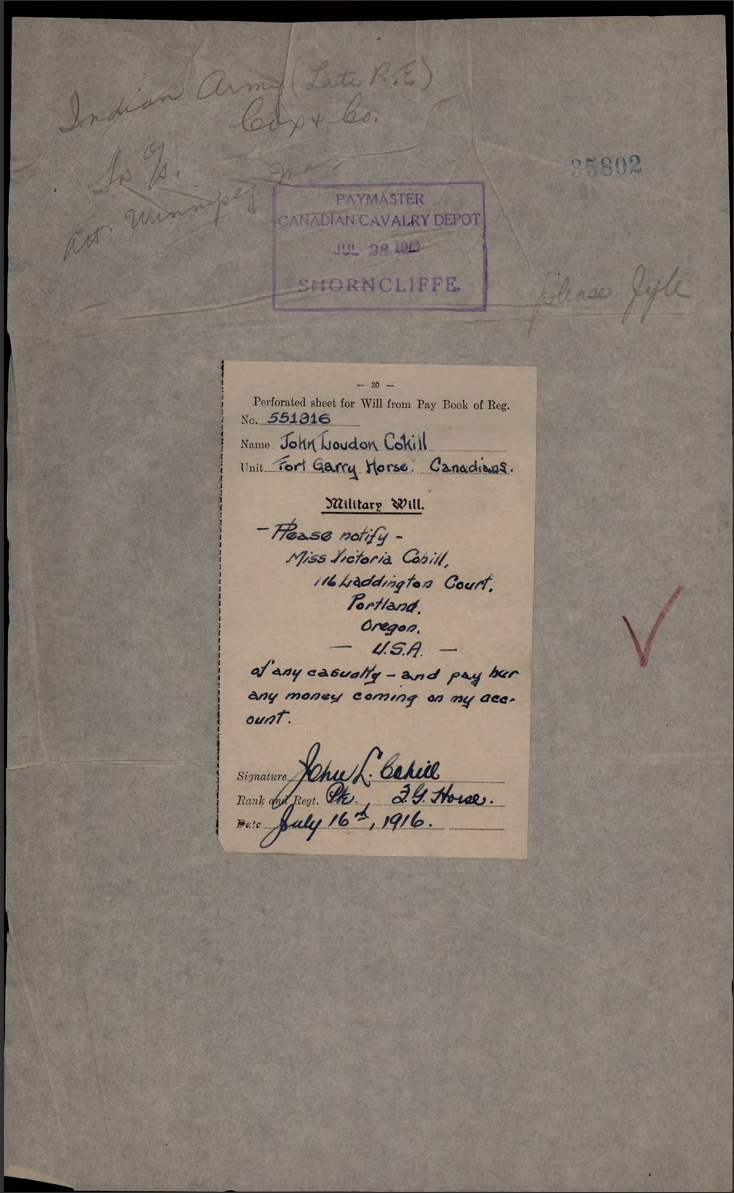
John Loudon Cohill Military Will. (Library and Archives of Canada)
On either February 28th or March 2nd of 1916, John enlisted in the Canadian Overseas Expeditionary Force in Winnipeg, Canada. On his enlistment records his “next of kin” was listed as “Miss Victoria Cohill”, with her address being listed in Portland, Oregon. John stipulated that Victoria should be sent news of “any casualty and pay her any money coming on my account.” John served within three regiments for Canada over the course of the war, starting with the Canadian Corps Depot, then being transferred to the 34th Fort Garry Horse on August 7th, 1916, with whom he spent the bulk of his service, and finally being transferred to the Imperial Cadets on March 1st, 1918. He saw service in England and France and notably took part in the Second Battle of Vimy Ridge in April of 1917 with the 34th Fort Garry Horse, where he was subsequently injured; the details of his injury have not been recorded. His military records make it clear that his total salary, which was $15 per month, was sent to Victoria from 1916 to 1918.
Sometime before 1916 Victoria moved to Portland, Oregon, with Juniata. Public records indicate that Juniata’s older brother, William Albert Robeson, moved to Wisconsin and subsequently to Portland sometime in the 1870s. William died in 1890, but his wife, Jennie Amanda Hicks, lived in Portland until her death in 1937. Victoria lived in Oregon for the rest of her life as well, dying there on April 7th, 1967. Victoria was married twice, first on August 21st, 1925, in Portland to Ralph Henry Campbell, with whom she had at least two children. Ralph died in 1946 and Victoria remarried on August 6th, 1960, to Lewis Frazier Shaw Sr., who would die only three years later in 1963.
On May 31st, 1917, Andrew officially enlisted in the United States Army with the 15th Engineers serving as a Private in Company D of the regiment; more than a month after the Second Battle of Vimy Ridge and more than six-months since his last correspondence from John. Affectionately referred to as the “Pittsburgh Pioneers”, the 15th was constituted on June 3rd, 1916, in Oakmont, Pennsylvania and was the first engineering regiment to be sent abroad by the United States during the First World War. They were responsible for the planning and constructing of railroads, barracks, hospitals, and supply depots, and likely would not have taken part in direct combat but would have been overwhelmingly surrounded by it. Andrew enlisted in Braddock, Pennsylvania, and was deployed to France, with the rest of his regiment, in July 1917.
The 15th, and subsequently Andrew, were present at the Battle of Saint-Mihiel and the Meuse-Argonne campaign. The Meuse-Argonne campaign went on for almost three months in 1918, beginning on September 26th, ten days after the end of the Battle of Saint-Mihiel, and ending with the armistice agreement on November 11th. Well-known as one of the deadliest campaigns of the war for the American Expeditionary Forces and one of the first to be affected by the 1918 influenza pandemic, we can only imagine how stressful the next 47 days would have been for Andrew and all members of the armed forces.
Andrew’s personal experiences of his WWI service have unfortunately been lost to time. Andrew’s children and grandchildren have varying knowledge of his service, with the eldest of them having photos of him in uniform to the youngest being completely unaware that he had served at all. It was noted once by one of his daughters, Mary Jane Cohill-Miller, that he had spoken fondly of his time in France, but of course nothing could be said about his service. Andrew is not alone in this. The First World War brought about the idea of PTSD, first referred to as shell shock. Discussions of traumatic events, such as extended periods of bombardment and excessive violence, were not encouraged and were often negatively stereotyped. In the early 20th century, WWI veterans were often labeled as “weak” or “cowards” for speaking in any way that was not positive regarding their experiences in the war, such stigma led many to neglect sharing their experiences at all. I think it’s especially telling that the only recollections of Andrew’s that survive focus on being in France and not on anything related to the war.
Andrew was discharged on May 15th, 1919, along with the rest of his regiment at their demobilization. The 15th Engineers have remained active since WWI, taking part in the Second World War, The Korean War, Vietnam, and the conflicts of 2008. They currently exist as a part of the 7th Engineer Brigade, and their headquarters are in Grafenwoehr, Germany. Likewise, John was discharged on either May 31st or June 1st, 1918, but continued his service until 1920 as a 2nd Lieutenant with the Royal Engineers, a British regiment, with whom he saw further service in Bombay, now Mumbai, and Meerut, India.
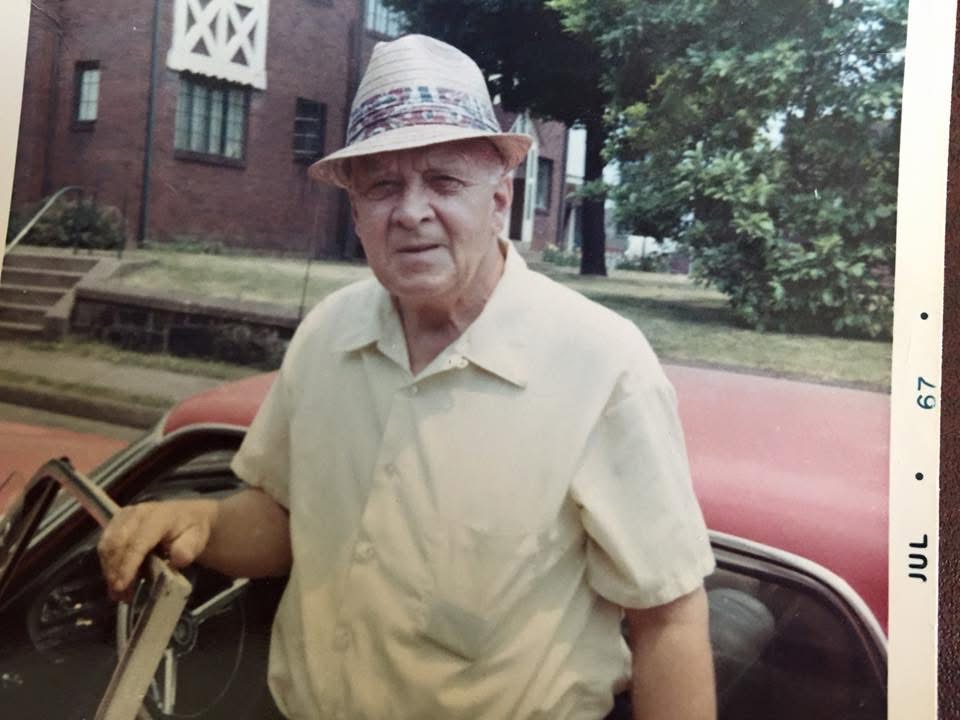
Andrew Cohill in 1967.
After being discharged, Andrew returned to Pittsburgh and worked as a shipping clerk at the John F. Casey Company, a constructing and engineering firm. Sometime before 1921 Andrew met, and married, Stella M. Reilly. The couple lived in Swissvale, a borough of Pittsburgh, from the time of their marriage until both of their deaths, Stella’s being on June 22nd,1967 and Andrew’s being on March 10th, 1976. Together the couple had a total of nine children, forty-six grandchildren, and eighty great-grandchildren; I count myself as lucky to be one of the eighty.
After completing his service for the Royal Engineers, John briefly returned to Altoona, before returning to Calcutta, India, to work in the automotive business. This venture led him to working with Firestone Rubber Co. from 1926 until sometime in 1961. John served Firestone’s international operations in India, South Africa, Argentina, and finally in Akron, Ohio, as Vice President of Firestone de la Argentina, Manager of Firestone’s Bofors Plant—making anti-aircraft guns during WWII, Vice President of Firestone Aircraft Co., Vice President of Firestone International, and finally as Vice President of Non-Tire Subsidiaries. John got married to Galena Louise Day in Calcutta on October 27th, 1922, they had three children together. The two eventually divorced and John was remarried in Port Elizabeth, South Africa, to Mary Joyce Whipp on January 5th, 1939. They remained married until his death on November 27th, 1969.
Neither John nor Victoria had any contact with Andrew’s children or grandchildren. It’s been noted by several of Andrew’s family members that his children were aware of them both but never met and were unsure if John and Victoria were aware of them. Andrew’s level of contact with either of his siblings post-WWI is unknown. I find it notable, however, that Andrew’s youngest son, and ninth child, was named John. John, born in 1942, went on to have four children, the third of which was named Victoria.

Katherine Haun
Katherine Haun is a rising senior at the University of Illinois-Urbana Champaign, majoring in history and minoring in creative writing. Currently, she works as an intern at the Michigan Supreme Court Historical Society, working with their extensive portrait collection and writing in various capacities for the organization.
Katherine resides in the Greater Lansing area, but grew up in Detroit, Michigan. Her personal historical interest is in British History spanning from the medieval era to the 19th century, along with the Italian Renaissance
External Web Site Notice: This page contains information directly presented from an external source. The terms and conditions of this page may not be the same as those of this website. Click here to read the full disclaimer notice for external web sites. Thank you.