|
|
|
|
January 2020
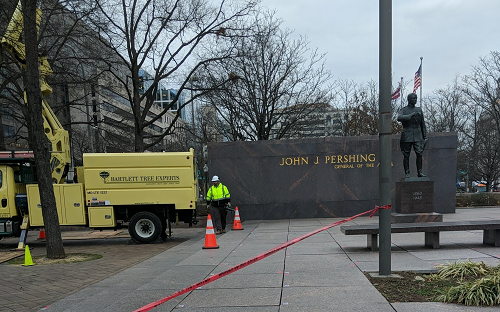
Phase I construction work is underway at the site of the new National World War I Memorial in Washington, DC. A construction fence now surrounds the site. Click the photo for more information and photos of the ongoing work.
|
|
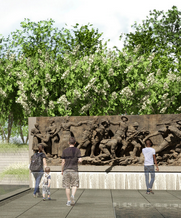
The Evolution Of A Modernist Memorial
World War I Planted the Seeds of the Civil Rights Movement in the United States

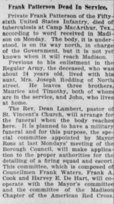
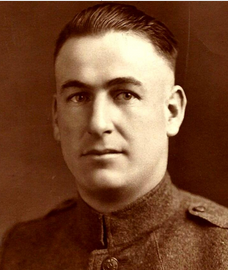
American Legion Post 43 in Florham Park, New Jersey is named after Pvt. Frank A. Patterson of Madison, NJ. Patterson was struck down by the greatest killer of the war, against which all of his training and equipment provided no defense. The battlefields of World War I are well known for their ability to take human life on an industrial scale. But the war's most insidious killer was disease. Infectious diseases such as influenza, pneumococcal meningitis, and tuberculosis claimed the lives of tens of thousands of American soldiers. Click here to read more about Frank Patterson's tragic fate, and his service that is remembered today in an American Legion post.
|

American Legion Post 182 is named after Manuel "Mannie" E. Reams, who served in the American Expeditionary Force during the First World War. Reams was born in February 1890 in Suisun, California. He attended local schools in the area and, between the years 1910 and 1915, made a name for himself playing semi-pro baseball where his teammates gave him the nickname "Babe." But Reams left the ball fields for the battlefields of World War I, never to return. Click here to read more about a hero in sports and real life is remembered by his hometown American Legion post.
|

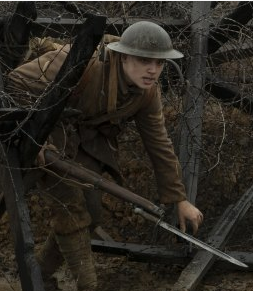
Lewis Beale, writing in the Los Angeles Times, asserts that Director Sam Mendes' new film, "1917" is "in its own way, every World War I movie in microcosm: the trenches, the scarred battlefields, the rats, the gruesome deaths, the utter futility of a conflict fought over minuscule pieces of land; a war that seems to make no sense, despite the heroism of its combatants." Click here to read more about how cinematic storytelling about war differs between WWI and WWII, and also between movie makers in America and those in the rest of the world.
|

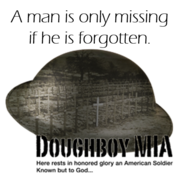
A man is only missing if he is forgotten.
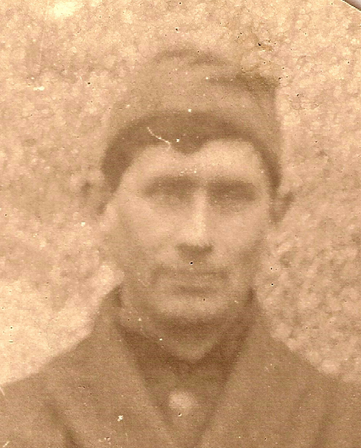
Our Doughboy MIA this month is Private Charles B. Jeffries, born 21 July 1892 in Columbus, Ohio, the only son of Van and Ada Jeffries. He and his sister Mary would grow up in Columbus. Charles' draft card shows him to have been a time keeper at the Ralston Car Company on registration day, and he tried to claim exemption for having a 'bad throat'. He was 5'6" tall, blond, and slight of stature.
Bad throat or not, Charles received his draft call in May, 1918 and on the 31st of that month was inducted into the army at Camp Jackson, South Carolina. He trained with Battery C, 15th Battalion, Field Artillery Replacement Draft before sailing for overseas service with the 14th Battery, Field Artillery Replacement Draft (part of the Camp Jackson July Automatic Replacement Draft) on his 26th birthday, 21 July 1918.
Once in France, in August Jeffries was sent as a replacement to the 77th Division, by then heavily engaged in combat in the Vesle sector, and assigned to Battery D, 305th Field Artillery. As an inexperienced replacement, he was assigned duty as a runner with the battery. In September, when the 77th moved into the Argonne Forest, Private Jeffries, along with Private Thomas G. Sadler, found himself attached as runner to Lieutenant John P. Tiechmoeller, who by then was the artillery liaison officer from Battery D assigned to 1st Battalion, 308th Infantry. Lieutenant Tiechmoeller's job was to assist the infantry in its attack forward by calling in artillery fire on stubborn targets of resistance and targets of opportunity. However, in the jungle of the Argonne this job was dubious at best, and the three artillerymen were looked upon with a certain amount of derision.
By October 3rd, Jeffries, Sadler and Tiechmoeller found themselves in the Charlevaux Ravine as part of Major Whittlesey's 'Lost Battalion'. There, on 4 October, while surrounded in that ravine, Whittlesey's men faced an hour and a half artillery barrage by their own division's guns, from 2:30 pm until about 4:00 pm; a situation inadvertently set in motion by a set of incorrect map coordinates sent back by Lieutenant Tiechmoeller the previous day. It was during that terrible barrage that Lt. Tiechmoeller later recalled seeing Private Jeffries running for the cover of his funk hole in the hillside. That was the last anyone saw of him.
When Tiechmoeller – himself wounded during the barrage – later went to search for Jeffries after the position was relieved, all he found was the boys smashed in the funk hole. Ironically, Private Jeffries was more than likely killed by fire from the guns of his own battery.
Though no trace of Jeffries was ever found, there were five sets of remains from the episode in the Charlevaux Ravine that remain unidentified to this day.
Would YOU like to be a part of our mission of discovering what happened to our missing Doughboys from WW1? Of course you would, and you CAN! Simply make a donation to the cause and know you played a part in making as full an accounting as possible of these men. Large or small doesn't matter – that you cared enough to help does. Visit www.ww1cc.org/mia to make your tax deductible donation to our non-profit project today, and remember:
A man is only missing if he is forgotten.
|
|
|
|

Submitted by: Robert E. Carlson
Harold Edward Carlson born around 1892. Harold Carlson served in World War 1 with the United States Army . The enlistment was in 1918 and the service was completed in 1919.
Story of Service
Harold Carlson, born Harald Eugen Karlsson, on November 3, 1892, in Norrköping,Östergötland, Sweden, was orphaned in 1900, when his father died. He immigrated to Brooklyn, New York, to live with his mother's sister, Mathilde Jensen and his uncle Jens (John) Jensen. It was a crowded house with his sister, another aunt, three cousins and a border, who was my grandmother's brother.
Harold drove a horse-drawn wagon for a warehouse business, as a young man. When the war broke out, he was inducted as a teamster. Harold kept a notebook that listed his duty stations from his induction to his discharge. This is his entry: "May 28, 1918 left home for Camp Upton. Left Upton June 13, 1918 for Camp Johnston, Fla. Arrived the 16th. Left Johnston Aug. 2. To Camp Hill 4. From Hill to France 14. Arrived in Brest 26. Sept. 4 to Sougy 8th (arrived). From Sougy June 2, 1919. From Lemunox 3, 1919. St. Gearvas 12th."
|
|
|
|
|